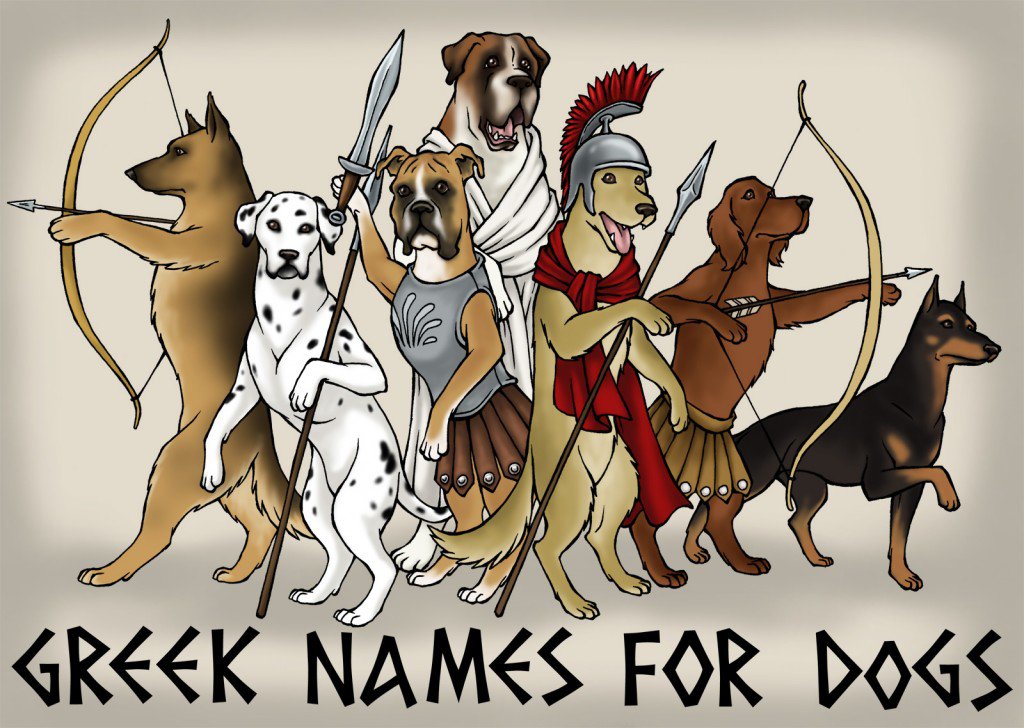
Choosing Greek Myth Dog Names
Is there a secret to naming dogs? The pantheon of Greek heroes, gods, and monsters offers a variety of cool and unusual names for male dogs. Keep in mind that the name you choose should reflect the qualities of the canine companion you desire from the pup you’re going to share your life with. Greek myth dog names can bestow power, bravery, genius, as well as immortality.
If you’re looking to team up with a cool Greek hero or god, here is a list of some of the more intriguing male characters of Greek mythology, along with their stories and a few tips on how to choose the one that’s right for your dog’s unique character.
In This Article
- List of Greek Olympic Gods and Their Roman Counterparts
- Historical Greek Names for Male Dogs
- The Best High-Energy Dog Name
- Greek Mythical Heroes for Obedient Dogs
- Greek God Names for Fast Dogs
- Loyal Dog Names From Ancient Greek Myths
- Greek Dog Names for Fraternity, Loyalty, and Love
- Cool and Powerful Greek Guard Dog Names
- Heroic Greek Names for Strong Dogs
- Greek Mythology Names for Herding Dogs
- Unique Greek God Names for Gentle Dogs
- Badass Mythical Greek Monsters and Canines
- Mythic Lands of the Ancient Greeks
- More Unique Greek Myth Names: Primordial Gods and Personifications
Historical Greek Names for Male Dogs
Have you discovered that your new canine companion seems to know what you want and is capable of anticipating your wishes? Celebrate your pup’s cleverness by choosing a name that honors his willingness to please.
These luminaries of Greek philosophy and historical records make impressive names for “old soul” pups.
Alexander: Alexander the Great, or Alexander III of Macedon, conqueror of the known world in the 300s BC. Name your boy Zan or Zander for short.
Archimedes: Famous Greek mathematician, inventor, astronomer, physicist, and founder of Syracuse. Call your dog Archie for short.
Aristotle: Greek philosopher, Ari is the nickname.
Arrian: Arrian of Nicomedia was a Greek historian, commander, philosopher, and the best historical resource for the campaigns of Alexander the Great.
Duris: Duris of Samos, a Greek historian and one-time tyrant of Samos.
Euclid: Ancient Greek mathematician, considered the father of geometry.
Gallant: Thomas Gallant, modern Greek historian and archeologist.
Graves: Robert Graves, poet and historical novelist, as well as prominent translator of ancient Greek texts and classical Latin texts. He is best known for I Claudius and Claudius the God.
Herodotus: Greek historian and geographer, best known for his histories of the Greco-Persian Wars.
Homer: Greek poet and author of the lyric poems The Iliad and The Odyssey, which recount the final years of the Trojan War and Odysseus’s unending journey home after the war.
Onassis: Aristotle Onassis, Greek shipping tycoon and the world’s first known billionaire.
Philip: Philip II of Macedon, King of Macedon and father of Alexander the Great.
Plato: Greek philosopher, student of Socrates and teacher of Aristotle.
Plutarch: Greek philosopher and priest at the Temple of Apollo at Delphi.
Socrates: Greek philosopher, considered the founder of modern philosophy.
Timaeus of Tauromenium: Author of The Histories, some 38 volumes dedicated to the histories of Sicily and Greece. Name your dog Timaeus and call him Timmy for short.

The Best High-Energy Dog Name
Chaos or Khaos: The mythological name Chaos is often chosen for high-energy dog breeds that are active in high-drive canine sports, such as agility, herding, flyball, and fast cat.
Chaos is a “primordial” Greek god. Translated from Greek, chaos means “emptiness,” “vast void,” “chasm,” and “the abyss.” The modern definition of chaos is an unordered and formless primordial mass. While Chaos in itself is neither male nor female, from Chaos sprang the building blocks of earth, the Titans as well as the Olympians, and all other life forms.
Chaos produced Gaea (Mother Earth), Tartarus (the embodiment of the underworld), Erebus (a symbol of dark silence), Eros (love), and Nyx (the embodiment of darkness). Name your wild puppy Chaos, and in time will come love, obedience, and order.
Greek Mythical Heroes for Obedient Dogs
Cadmus: Legendary founder of Thebes, Cadmus, by virtue of his ability to follow the instructions of various kings, oracles, gods, and goddesses, built the city of Thebes and fathered a line that figures prominently in many of the mythological Greek tragedies.
As Cadmus’ epic tale suggests, his name is likely to bestow superior powers on its owner as a stud dog and sports competitor. Read on to learn more about Cadmus’ extensive journey, filled with the slaying of monsters and the founding of ancient cities.
When Cadmus’ half-sister Europa was carried off by Zeus disguised as a bull, Cadmus’ father instructed him and his brothers to find her and not to return to the city without her. Given that the bull was no ordinary bull, the quest was long and fruitless. Exhausted from their search and unable to return home against their father’s wishes, the brothers found new homes.
Cadmus went with his mother to Thrace. When she passed, Cadmus went to see the oracle at Delphi to decide what to do next. The Oracle advised him to follow a cow with a white half-moon marking on its rump. Wherever the cow stopped, he was to build a city. Cadmus followed the oracle’s instruction, and when the cow collapsed in exhaustion, Cadmus made preparations to sacrifice her to Athena.
He sent members of his entourage to collect water for the purification of the sacrifice. When they did not return, he sent more. This continued until Cadmus was alone. He then went himself to the spring and found a dragon, lethargic from its feast, having consumed all of Cadmus’ men. Furious and unaware that the dragon was a son of Ares, Cadmus slew the dragon. Ares was enraged.
Alone and in need of companions, Cadmus sought Athena’s help. She advised him to sow half of the dragon’s teeth in the ground if he wanted companions and sow all of the teeth if he wanted warriors. Following her advice, Cadmus sowed half of the seeds and gave the other half to Athena.
However, Ares intervened, and fully armed warriors sprang up from the teeth Cadmus had sown. On Athena’s further advice, Cadmus threw stones among the warriors, and they, each thinking another soldier had thrown the stone, killed each other.
To atone for the crime of killing Ares’ dragon, Cadmus lived in service to Ares for eight years. When his service ended, he was married to Ares and Aphrodite’s daughter, Harmonia. The wedding was attended by gods and muses, and the marriage produced four daughters and a son.
Name your male dog Cadmus if you want a dog that can follow complicated instructions and live in many years of faithful service.
Pegasus: The white-winged stallion was fathered by Poseidon and foaled by the Gorgon Medusa upon her death, when the hero Perseus decapitated her and the white horse sprang from her neck. Pegasus assisted a number of heroes in their conquests of monsters, including Perseus and Bellerophon. Given his ability to assist heroes in their adventures, Pegasus makes a great dog name for a therapy or emotional support dog.

Greek God Names for Fast Dogs
The Greek myths are filled with tales of heroes possessing extraordinary abilities as athletes, warriors, and hunters. These tales of epic struggles inspired the creation of the ancient and modern Olympic games. Consider one of these unusual Greek names to inspire your canine athlete to the heights of his physical prowess.
Notus: The stormy south wind that brings late summer and early autumn rains, Notus was said to dwell in Ethiopia, the southernmost region of the mythical realm. When the four winds mated with the Harpies, they often produced magnificent, immortal horses.
Zelos: One of the winged enforcers of Zeus, Zelos is the god of envy, competition, and contest and was worshipped at the sites of the Olympic games. The words “zeal” and “zealous” are derived from his name.
Zephyr or Zephyrus: The gentle wind of the west that brings spring rains to awaken Mother Earth and the interceder between the world of the living and the underworld of the dead. Zephyr was the son of Astraeus and Eos, the goddess of the dawn; he was the father of the spring flowers and Achilles’ immortal horses.
Gentle, warm Zephyrus was the wind that guided Aphrodite to the sea of Paphos when she was born and the only wind Odysseus allowed to help him find his way home to Ithaca. Name your dog Zephyr if you want a fleet, agile dog with a warm disposition.
Loyal Dog Names From Ancient Greek Myths
These Greek heroes of myth are unquestioning in their obedience and loyalty to their masters: Argos, Atlas, Kratos, and Sirius. Consider one of these faithful companions’ names to inspire your dog’s unshakable loyalty. Here are their stories.
Argos: Odysseus’ faithful dog. After nearly a 20-year absence from his home, Odysseus returns to find his home is overrun by suitors for his wife Penelope’s hand in marriage. As Odysseus enters his home, no one recognizes him except Argos, who is in a state of terrible neglect and old age.
Argos raises his head and wags his tail to greet his returned master. Odysseus must remain undercover to deal with presumptuous suitors and passes by without acknowledging Argos. Odysseus sheds a tear for his old friend as he passes, and then Argos lays down his head and dies.
Atlas: One of the Titans, his name means “hard and enduring.” In the battle between Zeus and Cronus, Atlas led the charge against Zeus. For this, Zeus singled out Atlas for the greatest punishment of all. Atlas must bear the heavens, also known as the celestial sphere (often mistaken for Earth), on his shoulders. Name a powerful working dog Atlas, and he will live in long service to his master.
Kratos: Kratos is the brother of Nike, Bia, and Zelos. He is the god of power, strength, and sovereign rule, and he and his siblings are winged enforcers of Zeus. It is Kratos who chains Prometheus to the Rocks of Caucasus as his punishment for giving fire to mankind. Kratos does not pass his own judgments on man or gods; he exists to do Zeus’ bidding and performs his tasks without judgment.
Sirius the Dog Star
Sirius: The Dog Star and Companion of Orion. Orion was known as the “most beautiful of the Earthborn” and the greatest mortal hunter. Sirius was his faithful canine hunting companion and the most famous canine in Greek mythology.
After Orion boasted of his plan to kill all wild beasts on Earth, Mother Earth grew concerned and sought assistance from Zeus. Given Orion’s hunting prowess, the gods shared Mother Earth’s concern, and they sent a giant scorpion to battle Orion. Its thick external skeleton was impenetrable to swords and spears, and in time, it stung Orion to death.
Artemis, Orion’s hunting companion, mourned his passing and placed Orion in the heavens as a constellation. His dog, Sirius, remained on Earth, searching ceaselessly for his master. Artemis took pity on Sirius and eventually placed him at his master’s side in the heavens. If you are looking for an eternally faithful hunting companion, name him Sirius after the Dog Star.
Greek Dog Names for Fraternity, Loyalty, and Love
Castor and Pollux were the twin sons of Leda and the brothers of Helen of Troy and Clytemnestra. They are known collectively in Greek as the Dioscuri and were worshiped extensively in Sparta.
In the myth, the twins shared the same mother but had different fathers; Zeus was the father of Pollux (which meant that Pollux was immortal), and Castor had a mortal father. When Castor died, Pollux grieved for his twin greatly and asked Zeus to let him share his own immortality with his brother to keep them together.
Zeus transformed them into the Gemini, the brightest star constellation. They spend alternate days together in Hades and in the Heavens. If you are seeking an inseparable bond with your dog, name him Castor or Pollux.
Cool and Powerful Greek Guard Dog Names
Achilles: Achilles was the son of Thetis, the beautiful nymph, and Peleus, the king of the Myrmidons. Initially, Zeus and Poseidon were rivals for the hand of Thetis until Prometheus, a seer of future events, forewarned Zeus that Thetis would bear a son greater than his father. Not wishing to repeat the history of the Titans, the two gods withdrew their pursuit and encouraged her to wed Peleus.
Seeking to make her son invulnerable, Thetis held him by his heel and dipped him in the river Styx. In his youth, Achilles was trained by the centaur Chiron in the art of war alongside Ajax the Great. Seemingly invincible, Achilles was the greatest warrior in Agamemnon’s army and perhaps of his generation. He is notable in the Trojan War first for his refusal to fight (dooming the Greek army to defeat) and then for rejoining the Greeks to avenge Hector’s killing of his friend Patroclus.
Achilles’ killing of Hector ensured the fall of Troy. Then Paris, the abductor of Helen, slayed Achilles with an arrow directed by Apollo to the tendon of his heel, where his mother held him when she submerged him in the river Styx. Remarkably, Achilles died from the small wound.
Achilles’ name means “grief of the people,” and grief is a frequent theme in Achilles’ legend as well as throughout the epic of the Trojan War. In modern times, his name is associated with glory in war. Name your dog Achilles if you mourned the loss of a treasured companion before allowing a new canine companion in your life.
Andronicus: Classical Greek name meaning “victorious male.”
Bia: Son of Pallas and Styx, Bia means “force, power, and might.” Bia is the personification of anger or raw energy.
Griffin: A mythical creature with the body of a lion and the head, wings, and talons of an eagle. These powerful creatures were said to live in northern Greece, where they guarded vast treasures. Name your faithful guard dog Griffin, and you can call him Griff for short.
Hydra: The Hydra was a serpent or dragon with nine heads that guarded the Lake of Lerna, an entrance to the Underworld. Chop off a head of the Hydra, and two grew back in its place. Hercules destroyed the Hydra by decapitating each head and swiftly cauterizing the neck with a torch before each new head could form.
Kratos: Son of Pallas and Styx, Kratos is the personification of strength. His siblings are Nike (victory), Bia (force), and Zelus (glory).
Minotaur: This mythical abomination was comprised of the body of a man with the head of a bull. The minotaur raged in a labyrinth beneath Crete, where it was annually fed seven sacrificial youths and seven maidens. Name your puppy Minotaur if you are seeking a man-eating guard dog.
Pallas: Pallas, known as the Giant and husband of Styx, was the Titan god of springtime warcraft. Pallas is father to an array of minor gods, including Nike, Bai, Zelus, Kratos, Scylla, Fontes (fountains), and Lacus (lakes).
Perses: Brother to Pallas, his name means “to sack or destroy.” Perses is father to Hecate, the most revered goddess of magic and witchcraft, by Zeus. Name your puppy Perses, if he has ransacked your closet and destroyed your favorite shoes.
Scylla: Derived from Greek, meaning “dog-shark,” the Scylla was a sea monster with 12 legs and six long necks, sporting dog-like faces with three rows of shark teeth on each face. The voice was that of a kennel of barking dogs, and Scylla eagerly consumed sailors whose ships passed by too closely. The Scylla consumed six of Odysseus’ men with its many darting heads.
Sphinx: Guardians, often flanking the entrances to temples, sphinxes have the body of a lion, wings of an eagle, and the head of a human. The Egyptian sphinx is male, while the Greek sphinx is depicted as female.
Zellus or Zellos: Son of Pallas and the mighty Styx, Zellus is an energetic mixture of the personification of anger, zeal, dedication, rivalry, envy, and competition. His Roman counterpart, Invidia, is associated with one of the seven deadly sins, Envy.
Zeus: The King of the Olympians
Zeus: The youngest of his siblings, Zeus is the king of the Olympian gods, god of sky and thunder, and rules over the Heavens and Earth. All gods, including the Titans, bow down to him.
Zeus is best known in Greek mythology for his amorous exploits, which resulted in a pantheon of gods as well as half-god, half-mortal creatures. His children are Aphrodite, Athena, Ares, Hermes, Dionysus, Hephaestus, Persephone, Apollo, Helen of Troy, the Dioscuri, Perseus, and Heracles, among many others.
Zeus is consistently a favorite dog name, regularly in the top 50 most popular male dog names year after year. It is certainly a powerful dog name, especially for a potential stud dog.

Heroic Greek Names for Strong Dogs
Ajax: Known as Ajax the Great (and stronger than dirt), he figures prominently in the Trojan War. Renowned for his great strength and good looks (he was considered the second best-looking man in Greece), he is described as being fearless, courageous, and having great combat intelligence. He was a man of colossal size and broad frame, trained in the arts of war by the centaur Chiron alongside Achilles.
As the second most valuable warrior in Agamemnon’s army (second only to Achilles), he is the only principal character in the Trojan War not to receive substantial help from the gods or be wounded in the battle. Name your dog Ajax if you are seeking a smart, courageous guard dog of colossal size and strength.
The Spartans: Austere, Brave and Disciplined
Spartan: Spartans were the citizens of Sparta, a Greek city that stood out in its day for its singular dedication to the art of war. Spartans were known to live a no-frills lifestyle, focusing from age seven and up on rigorous battle training. So austere were they that “spartan” is now a synonym for being rigorously disciplined, frugal, brave, and undaunted.
The Spartans were considered the greatest warriors of the ancient world, and their women enjoyed considerable freedom compared to the women of contemporary cultures. The film 300 recounts the tale of the 300 Spartans who fought to the death against the overwhelming forces of the Persians. While they ended in defeat, they did inflict heavy casualties on the Persians before their demise.
Spartan is an excellent name for any of the lean, short-coated bully breeds, including Pit Bulls, Dobermans, Boxers, and Chihuahuas. Call your dog Spartan if you want a cool, forthright, and well-disciplined companion.
Typhon: The most deadly creature of the Greek mythologies, Typhon was a serpent born of Gaia and Tartarus. The epic battle between Zeus and Typhon resulted in Zeus becoming the king of the gods and Typhon being cast into Tartarus, a deep abyss and dungeon for the imprisonment of the Titans.
Best Greek Mythology Names for Herding Dogs
Apollo: God of light and the sun, poetry, the healing arts, truth, and prophecy, and defender of herds and flocks, Apollo is one of the most important of the Olympian gods. He is an oracular god and the patron god of Delphi. As the leader of the Muses, he directs their choir. Interestingly, while he is associated with healing and is the physician to the gods, he can also bring about plagues and death with his arrows.
Apollo is the twin brother of Artemis and is depicted as an idealized beardless and athletic youth. He is often depicted with his bow and arrows and his lyre, created for him by Hermes.
Hermes: The god of animal husbandry, including cattle-herding, shepherding, and goat-herding, and of breeding of horses and mules. Known as a trickster, he is also the god of cattle thieves. As the messenger of the gods, he is depicted with winged sandals and cap; he moves easily between mortals and the divine and conducts souls to the afterlife. His Roman counterpart is Mercury. Name your herding dog Hermes or Mercury if he has a mischievous streak.
Pan: God of shepherds and flocks, Pan was part man and part goat. He had the pointed ears of an animal, a pug nose, small goat horns, and walked erect on goat legs and cloven hooves. His body was fully covered with hair, ending with a goat’s tail. Pan was born fully developed, so his mother ran away in terror when she first saw him. Hermes took pity on the abandoned child and brought him up to Mount Olympus, where he and the other gods delighted in him.
They named him Pan, meaning “all,” because he brought pleasure to all the gods. He was a particular favorite of Dionysus, god of wine. However, the nymphs were not as charmed by Pan, and a series of tales ensues wherein love-struck Pan pursues nymphs, only to find they would rather be turned into reeds or echoes than live as his consort. Name your herding dog Pan if you would like him to be a delight to all.
Unique Greek God Names for Gentle Dogs
Chiron: The civilized centaur.Centaurs were a race notorious for being wild and lusty, indulgent drinkers, and considered to be unfit for any useful purpose. Centaurs are half-man and half-horse, possessed of great size and strength and capable of inflicting great violence when intoxicated.
However, Chiron was unique among the centaurs. He was intelligent, civilized, and kind. A son of Cronos, he was immortal and did not share bloodlines with the other centaurs. Early Greek myths attribute his gentle nature and sophistication to his youthful tutelage under Apollo and Artemis.
Skilled in the medical arts, an astrologer, and a respected oracle, Chiron was said to be first among centaurs and was himself a highly revered teacher and tutor. Many Greek heroes are counted among his students, including Ajax, Aeneas, Actaeon, Caeneus, Theseus, Achilles, Jason, Peleus, Telamon, and Perseus. Call your dog Chiron if you are looking for a kind, intelligent, and obedient companion.
Phaethon: Son of Helios, the sun god, Phaethon begs his father to allow him to drive the sun chariot for one day. Despite Helios’ protestations, Phaethon insists, and his wish is granted. Sadly Phaethon cannot control the horses, and the chariot bounds high and low, scorching the Earth, thus creating deserts while leaving other areas frigid. As the heavens and Earth cry out for relief, Zeus strikes the boy dead with a single thunderbolt.
Titan: The elder gods, the Titans, predated the Olympians. Their king, Cronus, was the father of the majority of the Olympians. After being dethroned by Zeus, the Titans were banished to Tartarus. Notable Titans include Prometheus (who gave fire to mankind), Atlas (who bears the heavens on his shoulders), and Gaea (Mother Earth). Name your dog Titan if you need to subjugate a giant among dogs.
Badass Mythical Greek Monsters and Canines
Are you in need of a tough dog to guard your personal castle? Try one of these badass mythical monster names to strike fear in the hearts of those who would invade your homestead.
Argos: Odysseus’ faithful dog in Homer’s Odyssey.
Cerberus: The three-headed dog that guards the entrance to the underworld. One head sees the past, one the present, and one the future. Cerberus only has a taste for live flesh; therefore, no living man can enter the underworld. Cerberus also prevents the escape of souls from the underworld.
Griffin Beings Make Clever Greek Myth Dog Names
Cetus: Water-dwelling creatures with the forebody of wolves, leopards, and rams and the serpentine tails of fish. They are closely related to fishtailed horses.
Cynocephali: A race of dog-headed men believed to live in Africa and India. Their legend probably originates from baboons, viewed from a distance and mistaken for men.
Laelaps: When Zeus was a baby, a dog, Laelaps, known only as the “golden hound,” was charged with protecting the future King of Gods. Later, Zeus gifted Laelaps to Europa.
Orthrus (or Orthus): Two-headed dog and brother of Cerberus, the Sphinx, the Hydra of Lerna, and the Chimera, all whelped by the chthonic monsters Echidna and Typhon. He belonged to the three-bodied giant, Geryon, and he and Eurytion were charged with guarding Geryon’s herd of red cattle.
Heracles’ (Hercules’) 10th labor involved the capture of the red cattle, and Heracles slew Orthrus, Eurytion, and Geryon to get them. Name your dog Orthus if you are looking for an exceptional guard dog.
Panotii: A tribe of men with giant ears, which they wrapped around themselves to sleep at night. They also used their gigantic ears to fly.
Sirius: Orion’s faithful hunting companion, naturally Sirius mourned the loss of his master for a year as he wandered the Earth. Zeus, taking pity on the hound, added him to Orion’s constellation as its brightest star.
Yale: A mythical beast the size of a hippopotamus, with the tail of an elephant, rotating horns, and the tusks of a boar. It is typically described as being goat, antelope, or bullish in physiology.
Mythic Lands of the Ancient Greeks
Argos: Located in Eastern Peloponnesian, Argos was known especially for its horse rearing. Ruled by Agamemnon during the Trojan war, it is also believed to be the birthplace of the Greek hero Perseus, slayer of the Medusa.
Attica or Atticus (one from Attica): An ancient geographical region in Greece that includes Athens, Attica is also a correctional facility in Attica, New York, home of an infamous 1971 riot. In modern literature, Atticus Finch is the gentle, well-respected attorney and father in To Kill a Mockingbird. Naturally, Atticus Finch represents justice and moral fortitude. Name your dog Atticus if you want a kind, intelligent companion.
Ithaca: Greek island and Odysseus’ home. Following the fall of Troy, Poseidon cursed Odysseus to wander the Earth for 10 years and lose all of his crew before he could return to his homeland of Ithaca. Odysseus and his crew struggled through a series of trials that included a Cyclops, the Sirens, the clashing rocks Scylla, and the whirlpool Charybdis in order to return to his beloved Ithaca and wife, Penelope. Ithaca represents home, constancy, and faithfulness.
Troy: The high-walled city that lay under siege for nine years during the Trojan War following the abduction of Helen. The Greeks launched a thousand ships to conquer Troy and return Helen to her home and husband, King Menelaus.
More Unique Greek Myth Names: Primordial Gods and Personifications
Aeneas: Son of Aphrodite and ancestor of Romulus and Remus, Aeneas was a Trojan hero and the subject of Virgil’s Aeneid. Aeneas means “in-dweller,” referring to the concept of a god dwelling in a mortal body.
Aesop: A Greek storyteller and creator of a collection of eponymous fables.
Aeolus: Keeper of air and the winds and king of the island of Aeolia. Here he keeps the most violent winds in a cavern, released only at the request of the greatest of the gods.
Aether: Primordial deity of the upper atmosphere.
Agamemnon: Agamemnon commanded the united Greek forces during the Trojan War. King of Argos and father of Electra and Orestes, he was murdered by his wife and her lover upon his return from the war. His children, Electra and Orestes, plotted to avenge their father’s death.
Alastor: Spirit of vengeance and family feuds.
Ambrosia: The food and drink of the gods.
Andronicus: Ancient Greek for “male victor” or “male warrior.”
Aquarius: Also known as Ganymede, a beautiful youth who was taken to Mt. Olympus to be cupbearer to the gods.
Ares/Aries: God of war.
Aristotle: Ancient Greek philosopher and scientist, considered one of the founders of Western philosophy.
Bacchus: Roman god of wine.
Balius: One of a pair of immortal horses. Balius and Zanthus were the sons of a harpy, Podarge, and the West Wind.
Baltazar: Ancient Greek name and one ascribed to one of the Magi.
Bellerophon: Famed for taming and riding the winged horse Pegasus and for slaying the Chimera.
Boreas: God of the North Wind.
Caerus: God of luck and opportunity.
Dionysus: Greek god of wine.
Elpis: The personification of the spirit of hope.
Eros: Greek god of love.
Eurus: God of the East Wind.
Galen: Ancient Greek physician, following in the medical arts of Hippocrates.
Hector: Son of King Priam of Troy and hero of the Trojan War. Hector was considered the ideal warrior. Late in the war, Hector was killed by Achilles, and his body was drug around Troy by Achilles for 12 days in revenge for the killing of Achilles’ friend, Patroclus.
Helios: Greek god of the sun.
Hephaestus: Lame god of fire.
Hero: Greek for “protector” or “defender.”
Hippocrates: Ancient Greek physician and father of modern medicine.
Homer: Ancient Greek poet and author of The Iliad and The Odyssey.
Icarus: Fitted by his father, Daedalus, with wings made of feathers and wax, Icarus was set to escape the tower of King Minos of Crete. However, Icarus failed to heed his father’s warnings and flew too close to the sun. Icarus soon found that his wings were melting as he approached the sun, and finally, they disintegrated, plunging him to his death in the sea. Icarus is a good name for a dog that does not like to listen.
Kratos: God of strength and power.
Midas: Greek king with the touch of gold.
Morpheus: Greek god of dreams.
Notus: God of the South Wind.
Oceanus: Titan god of the ocean.
Odysseus: Homer’s hero of The Odyssey; following the Trojan War, he spends 20 years attempting to return home to Ithaca.
Olympus: Mount Olympus is the home of the Olympian gods.
Orestes: Son of Agamemnon and brother of Electra, Orestes takes the life of his mother, Clytemnestra, in revenge for her part in his father’s death.
Orion: Famed hunter who bragged he would destroy all beasts on earth. Frightened by his boast, Gaia, Mother Earth, sent a giant scorpion to battle Orion. The scorpion won, and Zeus, out of respect for the hunter, placed him and his dog, Sirius, as a constellation in the heavens.
Orpheus: Poet and musician of great renown and happily married to Eurydice. When his beloved wife was bitten by a serpent and killed, he convinced the gods to allow him to enter Hades and retrieve her. They agreed under one condition, that he must trust that she is following him out of Hades and not look back, not even once. Emerging from Hades, Orpheus glanced back to soon, and Eurydice, who had been silently and faithfully following, was lost to him forever.
Paeon: Healer to the gods, Paeon’s skills were generally reserved for wars and brawls between the immortals.
Perseus: Slayer of the Gorgon Medusa, Perseus used her head in subsequent adventures to good advantage, as her eyes, even in death, could turn man and monster to stone. The slaying of Medusa produced the winged horse, Pegasus.
Phobos: The personification of fear.
Plato: Greek philosopher that figures prominently in Aristotle’s teaching.
Poseidon: Greek god of the seas.
Sophos: Ancient Greek name meaning “wise.”
Spiro: Ancient Greek name meaning “basket.”
Tantalus: Cursed by the gods for bringing ambrosia and the nectar of the gods to man, Tantalus suffers for all eternity. He stands in freshwater beneath the bough of a fruit tree. The fruit always remains just out of his reach, and the waters always recede from his reach when he bends to drink from the lake.
Theseus: Mythical king and founding hero of Athens.
Tiresias: Blind prophet who tells Oedipus that he, himself, is the murderer that he seeks. Additionally, he is visited by Odysseus in the first level of Hades, where he tells Odysseus how to return home to Ithaca.
Tartarus: Primordial force and deity.
Triton: Son of Poseidon and messenger of the seas.
Uranus: God of the sky.
Xanthus: One of two immortal Greek horses. Xanthos and his brother, Balius, drew the chariot of Achilles.
Xenon: Ancient derivative of Zeus.
List of Greek Olympic Gods and Their Roman Counterparts
| Greek | Roman | |
|---|---|---|
| Zeus | Jupiter | God of the sky and king of Olympus. |
| Hera | Juno | Wife and sister to Zeus, queen of Olympus, goddess of marriage. |
| Poseidon | Neptune | God of the sea, brother to Zeus. |
| Hades | Pluto | God of the dead, king of the Underworld. |
| Aphrodite | Venus | Goddess of love and beauty. |
| Apollo | Apollo | God of music and healing, a hunter, twin to Artemis. |
| Artemis | Diana | Goddess of the hunt and protector of childbirth. |
| Ares | Mars | God of war, Ares is an irritable and moody god eyed with some distrust by the other Olympians. |
| Athena | Minerva | Goddess of wisdom, war, favorite child of Zeus. |
| Hephaestus | Vulcan | God of fire and the forge, he makes the armor of the other Olympians. Lame from birth, he is also husband of the beautiful and faithless Aphrodite. |
| Hermes | Mercury | God of messages, sent between the living and the underworld. A trickster and friend to thieves, he is known for his winged sandals and hat. |
| Demeter | Ceres | Goddess of the harvest and mother to Persephone, who becomes queen of the Underworld. |
| Dionysus | Bacchus | God of wine, usually depicted with grapes surrounding his face. |

© 2013 Barbara Fitzgerald (originally published on Pethelpful.com)