If you think you’ve seen every kind of adorable cat the internet has to offer, think again.
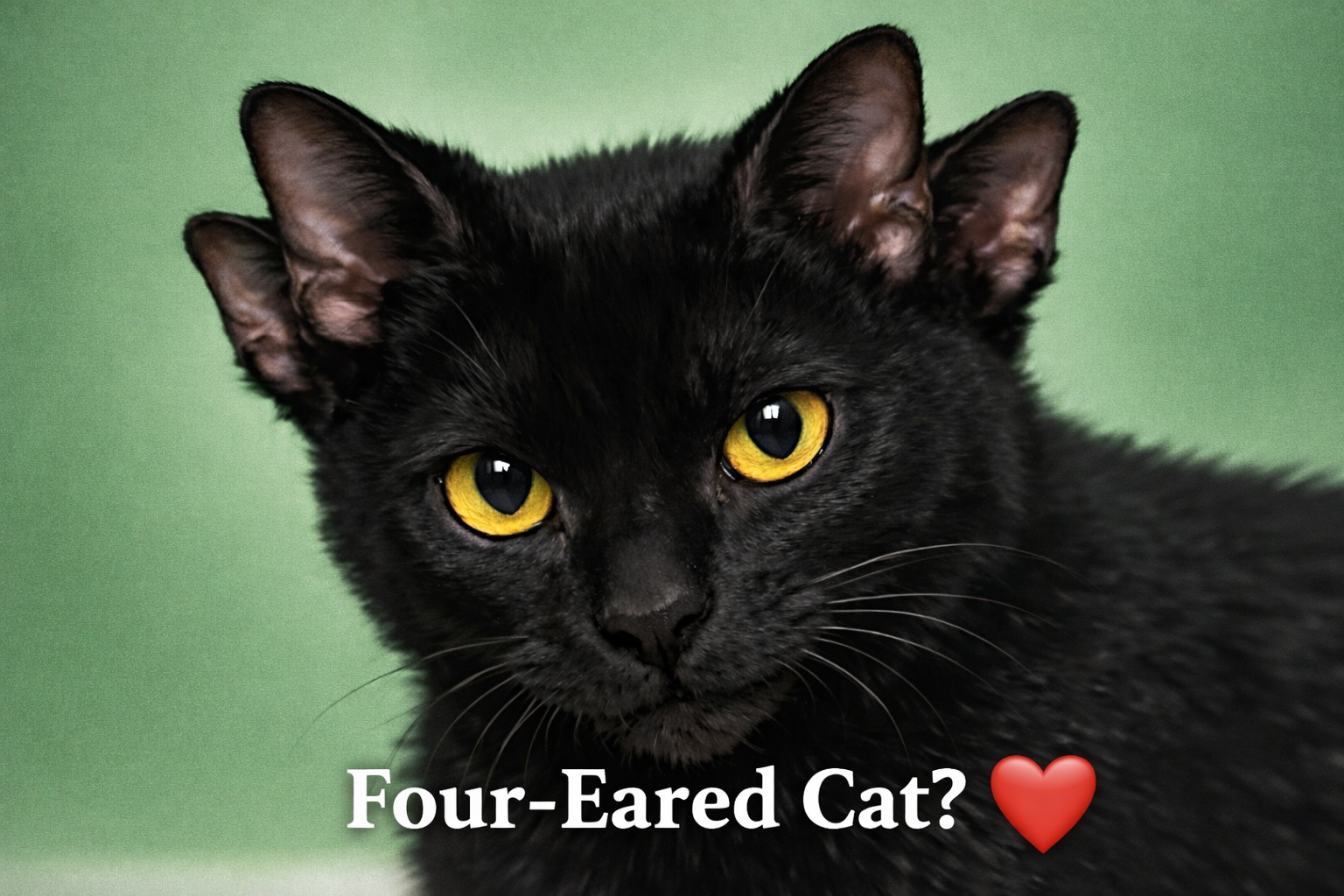
A recent YouTube video from WSYX ABC 6 introduces viewers to a truly unusual cat named Dobby. And yes, he really does have four ears.
In the clip, the hosts can’t quite believe what they’re seeing. “You’ve probably never seen a cat like this one before,” they say. “And no, you’re not seeing double.” Dobby was born with an incredibly rare congenital condition that gave him two extra ear flaps, along with a very short, curly tail and a noticeable underbite that will need surgical correction.
He’s currently being cared for by a foster family in Alabama. Once he’s fully healed and medically cleared, he’ll be ready for a forever home.
And judging by the reaction online, he won’t be waiting long.
What Causes a Cat to Have Four Ears?
While Dobby’s look is extraordinary, the science behind it is surprisingly grounded in embryonic development.
Cats, like all mammals, develop from a complex sequence of genetic instructions in the womb. Very early in pregnancy, tissues that will eventually form the ears, jaw, and parts of the skull begin to shape themselves from structures called branchial (or pharyngeal) arches.
If something slightly disrupts that developmental process (such as a spontaneous genetic mutation or incomplete tissue fusion) extra folds of tissue can form. In extremely rare cases, this results in additional pinnae (the external ear flaps).
Interestingly, in most reported cases of “four-eared” cats:
- The extra ears are external flaps only
- They are not connected to separate ear canals
- They do not provide additional hearing ability
In other words, Dobby probably doesn’t have super-cat hearing. The extra ears are almost certainly cosmetic, formed from duplicated outer ear tissue rather than fully functional auditory structures.
The “one-in-a-million” description used in the video isn’t far off. Cases like this are extraordinarily rare, and when they do occur, they often attract veterinary and even genetic interest because they offer insight into early developmental biology.
What About the Curly Tail and Underbite?
Dobby’s short, curly tail and underbite suggest that more than one developmental anomaly occurred.
A curly or shortened tail in cats is often linked to vertebral development differences. Some breeds, such as the Manx, are known for shortened tails due to genetic mutations affecting spinal development. However, in non-breed-specific cases like our friend Dobby’s, it’s interesting that it’s usually considered a congenital variation rather than a breed trait.
The underbite, however, is more medically relevant. In kittens, a significant malocclusion (misalignment of the teeth) can interfere with eating, cause trauma to soft tissues in the mouth, and increase the risk of dental disease later in life. Surgical correction may be recommended if the misalignment is severe.
The good news? These types of procedures are often very successful when performed early, and many cats go on to live completely normal, pain-free lives.
Is He Otherwise Healthy?
That’s always the big question when it comes rare congenital differences.
In some cases, visible anomalies can be linked to deeper structural issues, especially involving the skull or spine. However, experts say that many cats with external physical quirks actually live full, healthy lives.
Because Dobby is under the care of a foster family and presumably being monitored by a veterinarian, any underlying concerns would likely be addressed before adoption. Responsible rescues make sure unusual cases receive a full medical evaluation before placing them in permanent homes.
Based on the tone of the video (shown below), Dobby seems bright, comfortable, and well cared for. And that’s what matters most.
The Internet Reacts
The video doesn’t just showcase Dobby’s rare condition. It also highlights the kindness surrounding him.
One commenter wrote:
“The care giver here has a heart of a Angel. ❤”
And that sentiment captures something important.
It’s easy to marvel at a rare birth defect. It’s another thing entirely to step up and give daily care, veterinary support, and love to an animal who might require extra attention.
Foster families are the unsung heroes in stories like this. They take in animals who are unusual, overlooked, or medically complex, and they give them stability while the world watches from behind a screen.
If the video is anything to go by, Dobby has already inspired many people.
Will He Find a Home?
Almost certainly!
Animals with distinctive features often capture public affection quickly. From cross-eyed cats to three-legged dogs, social media has shown time and again that “different” often becomes “deeply loved.”
That said, future adopters must understand Dobby’s medical needs. If surgery is required for his underbite, that must be completed and followed by proper recovery care. Ongoing dental monitoring may also be necessary.
The right adopter won’t just see four ears. Instead, they’ll see resilience, uniqueness, and a kitten who deserves the same loving future as any other.
Why Stories Like This Matter
Beyond the cuteness factor, Dobby’s story offers something meaningful.
It reminds us that:
- Congenital differences don’t define quality of life
- Veterinary medicine can successfully address many structural anomalies
- Foster caregivers play a critical role in animal welfare
- “One-in-a-million” doesn’t mean “unadoptable”
Most importantly, it shows how compassion spreads. The short news clip from WSYX ABC 6 sparked curiosity, conversation, and admiration; not just for a rare kitten, but for the humans helping him.
If you’d like to see Dobby for yourself, you can watch the original video below:
And if the comments are right, it won’t be long before this four-eared little star is curled up in his forever home. Ears, curly tail, underbite, and all. 🐾
Further Reading on Four-Eared Cats:
- Four-Eared Cat Born With Genetic Mutation, But It Doesn’t Affect Hearing — Science Times (2023)
https://www.sciencetimes.com/articles/45039/20230724/four-eared-cat-born-genetic-mutation-condition-affect-feline-hearing.htm - Curious About Four-Eared Cats? Experts Explain How It Happens — NBC News / Science
https://www.nbcnews.com/science/cosmic-log/curious-about-four-eared-cats-flna6C10404847