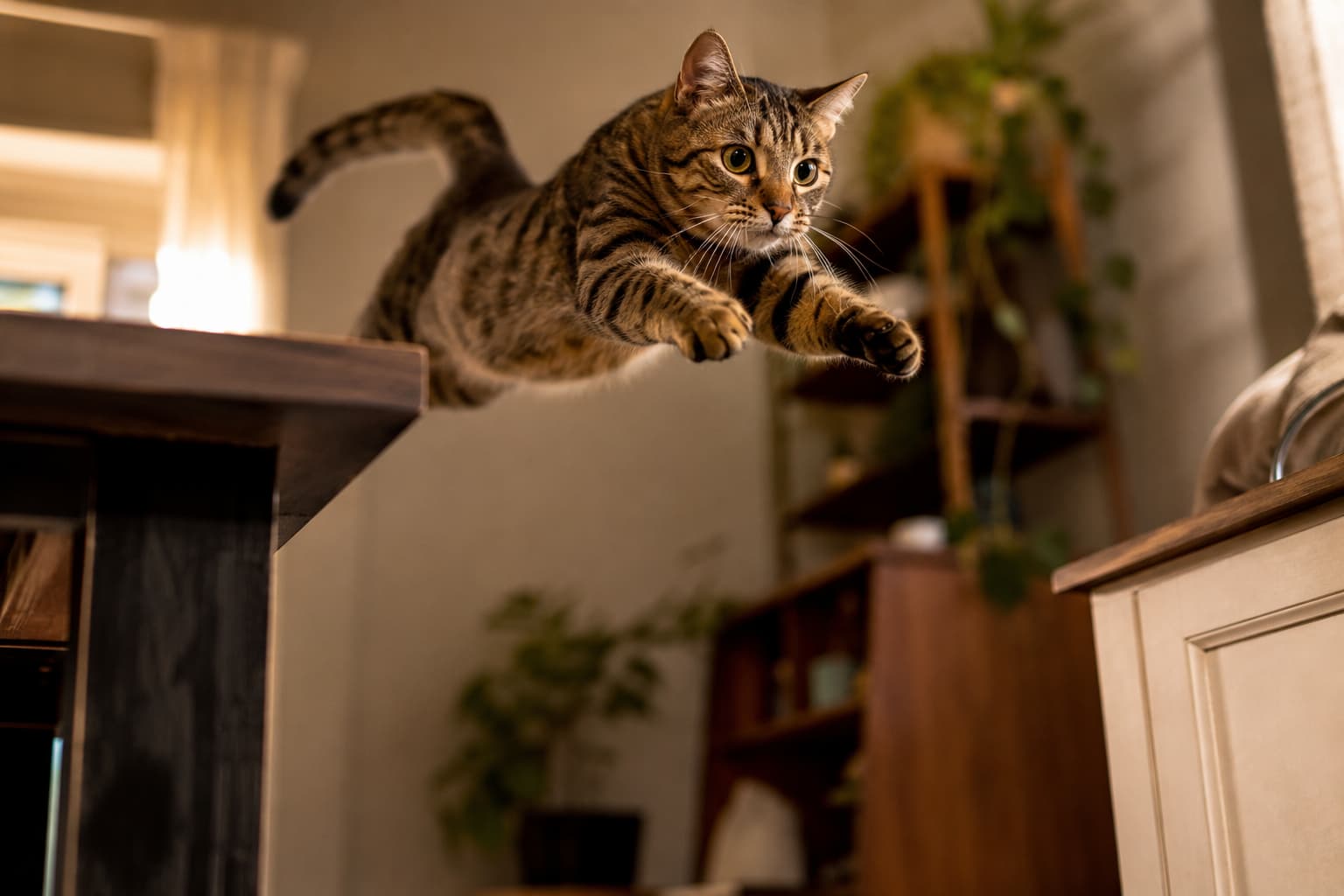
Do Cats Always Land On Their Feet?
Have you ever seen a cat land on their back? Probably not. And that’s kind of the whole problem. Because cats pull off that feet-first landing so reliably, so casually, that most of us just accept the old saying as fact, file it away, and never think about it again. We might ask, “Do cats always land on their feet?” and think “of course!” based on what we’ve seen in cartoons, viral videos, and the countless times a cat has jumped from somewhere ridiculously high and strutted away like nothing even happened.
Except, well…they don’t always land on their feet; not all the time. And that gap between “almost always” and “always” is where many of us cat owners or caregivers get caught off guard.
So let’s actually look at this thing properly, because the truth is actually quite a bit more interesting than the myth itself.

Where Does the Saying Come From?
Did you know that cats do have a real, documented ability called the righting reflex? It’s not folklore, but rather biology.
What happens is that when a cat senses it’s falling, structures in the inner ear detect the shift. As a result, the brain fires off a rapid sequence of corrections. The front half of the body twists one way, the back half the other, and the legs extend outward. And within less than a second, the cat has oriented itself to land feet-first. It’s highly coordinated, it’s fast, and it draws on the fact that cats have an unusually flexible spine. Plus, they have no proper collarbone to restrict their range of motion.
So yes, the reflex is real! And it works well most of the time. That’s the part the saying gets right.
But there are conditions. And the saying leaves all of them out.
The Part Nobody Talks About Is Minimum Height
Here’s something that surprises a lot of people. To complete the righting sequence fully, a cat needs a minimum drop of roughly 2.5-3 feet. Less than that, and there simply isn’t enough time or space for the reflex to finish what it started. Fascinating, right?
So, a short tumble off the arm of the sofa, a misjudged leap from the kitchen counter, a slip from a low shelf; none of those situations gives the reflex enough room to work. In this case, the cat doesn’t land gracefully on four paws. It lands however it happens to land! And depending on the angle and the surface, that rather unelegant dismount can mean a sprain, a fracture, or worse.
This is the type of fall that most owners don’t worry about because it looks minor. Suppose the cat bounces up and trots off, and everyone assumes it’s fine. Sometimes it is. Sometimes it isn’t, and, unfortunately, the signs often don’t show up until later.

What Is High-Rise Syndrome? (The Injury You’ve Probably Never Heard Of)
Veterinarians who work in cities have a name for what happens when cats fall from a height. They call it high-rise syndrome, which is a term first coined by vets in New York City in the 1980s. It came about after noticing a consistent pattern of injuries in cats brought in after falling from apartment buildings.
The Schwarzman Animal Medical Center (which pioneered much of the early research on this) published studies showing that these falls produced a recognizable triad of trauma: injuries to the chest, the limbs, and the face. Pulmonary contusions (bruised lungs) turned up in around 68% of cases. Pneumothorax, a collapsed lung, in about 63%. Facial trauma in over half. Limb fractures in roughly 39%.
Unfortunately, these are not minor injuries. And they don’t always look obvious from the outside.
For example, according to the Animal Medical Center, a cat who has fallen may be in shock and show very few visible signs in the immediate aftermath. By the time distress becomes apparent to the owner, the animal may have been suffering internally for quite some time (possibly hours).

Now Here’s the Crazy Part
So you might be thinking, “Alright, high falls are obviously dangerous”. That makes sense for sure. But let me offer some insight into where the science gets rather strange.
Research consistently shows that cats falling from greater heights (roughly seven stories or more) tend to survive with fewer serious injuries than those falling from two to six stories.
Read that again. Higher can be less dangerous.
The reason, according to researchers, is something called “terminal velocity”. After about five to seven stories of free-fall, a cat stops accelerating and reaches a stable falling speed. In fact, somewhere around 60 miles per hour. At that point, something shifts: the cat goes into relax mode. It might spread its limbs outward, arching like a parachutist. Doing this increases drag and distributes the force of impact more evenly across the body.
The 1987 study published in the Journal of the American Veterinary Medical Association, which reviewed 132 cats treated at the Animal Medical Center after falls from New York buildings, found that injuries actually increased with height up to seven stories. Then, it decreased above that point. One cat in the study fell 32 stories and was discharged after a few days with a collapsed lung and a broken tooth.
This sounds sort of miraculous, doesn’t it? And yes, it sort of is.
But there’s a major catch buried in that data, and it matters quite a lot. Those numbers only reflect the cats whose owners brought them in for treatment. The cats who didn’t survive long enough to reach a vet simply aren’t counted. In essence, the survival statistics are probably more optimistic than the full picture.
A 2022 review published in the Journal of Veterinary Emergency and Critical Care confirmed that while cats fare better than dogs in these falls due to the righting reflex and smaller body mass, the injuries sustained are still frequently severe and often need some intensive emergency treatment.

The Factors That Change Everything
Even setting aside height, several things can affect whether a cat’s righting reflex works as it should.
Age matters more than most people realise. Young cats are actually more vulnerable to falls in one sense: they’re curious and fearless, and they haven’t yet developed a reliable sense of distance. Older cats may have slower reflexes or weaker legs that can’t absorb the shock of landing, even a successful one. The Animal Medical Center notes specifically that less agile cats may not be able to reposition themselves in time.
Health plays a role, too. Anything affecting the vestibular system, which governs balance, can interfere with the righting reflex at the neurological level. A cat with an inner ear condition, for example, may not get the right signals fast enough to complete the rotation.
The landing surface is enormous. A cat landing feet-first on grass is absorbing a very different force than one landing on concrete or hardwood. The reflex is about orientation, rather than cushioning. The cat’s body still has to absorb whatever impact comes.
Surprise changes things. A cat that falls while fully awake and alert actually has a better chance of triggering the reflex quickly. One that slips while dozing on a sunny windowsill, or gets startled mid-leap, may not have the split second needed to start the sequence at all.
What This Means If You’re a Cat Owner
Please don’t panic; none of this is meant to be frightening. The righting reflex is a remarkable piece of feline biology! Fortunately, most indoor cats will go their whole lives without a serious fall.
But there are a few practical things worth keeping in mind.
For instance, say you live in an apartment or have any open high windows or balconies. Securing those spaces to protect your pet matters. Not because your cat will “definitely” fall, but more so, the consequences of an unsecured window can be severe. And this bears true even for a cat with a perfectly functional righting reflex.
After any fall (even one that looks fine), it’s best to watch your cat closely over the next several hours. Signs that something is wrong include limping, reluctance to move, laboured breathing, blood around the nose or mouth, or swelling anywhere on the face. PetMD and the Animal Medical Center both recommend treating any significant fall as a potential veterinary emergency. It helps to remember that internal injuries are not always visible.
And for what it’s worth, the lowest falls deserve attention too. A stumble from counter height can absolutely cause injury if the reflex doesn’t have room to kick in. Those are the falls that tend to get dismissed the most, which is probably why they catch people off guard.
So, Do Cats Always Land on Their Feet?
Most of the time, yes! Under the right conditions, with enough height to activate the reflex, with a healthy and alert cat, falling onto a forgiving surface. In those circumstances, yes, the odds are genuinely in their favor!
But “always” is a word that closes the door on a lot of important nuance. The truth is that cats land on their feet far more often than most animals would, thanks to a real and impressive biological mechanism. And also that they sustain serious injuries from falls all the time, that lower falls can be more dangerous than expected, and that even a good landing doesn’t rule out internal trauma.
The saying has been around long enough that it feels like fact to many of us. But like a lot of things that feel like fact, it’s really just most of the story. The rest of it is worth knowing, too.
If your cat has taken a fall and you’re not sure whether to seek care, please err on the side of caution and call your vet. You can also reach our team directly through the Ask a Vet feature on the site.
Sources:
- Schwarzman Animal Medical Center. High-Rise Syndrome in Cats. amcny.org
- Lefman & Prittie. High-rise syndrome in cats and dogs. Journal of Veterinary Emergency and Critical Care, 2022.
- Journal of the American Veterinary Medical Association. Study of 132 cats, Animal Medical Center of New York, 1987.
- PetMD. High-Rise Syndrome in Cats. petmd.com