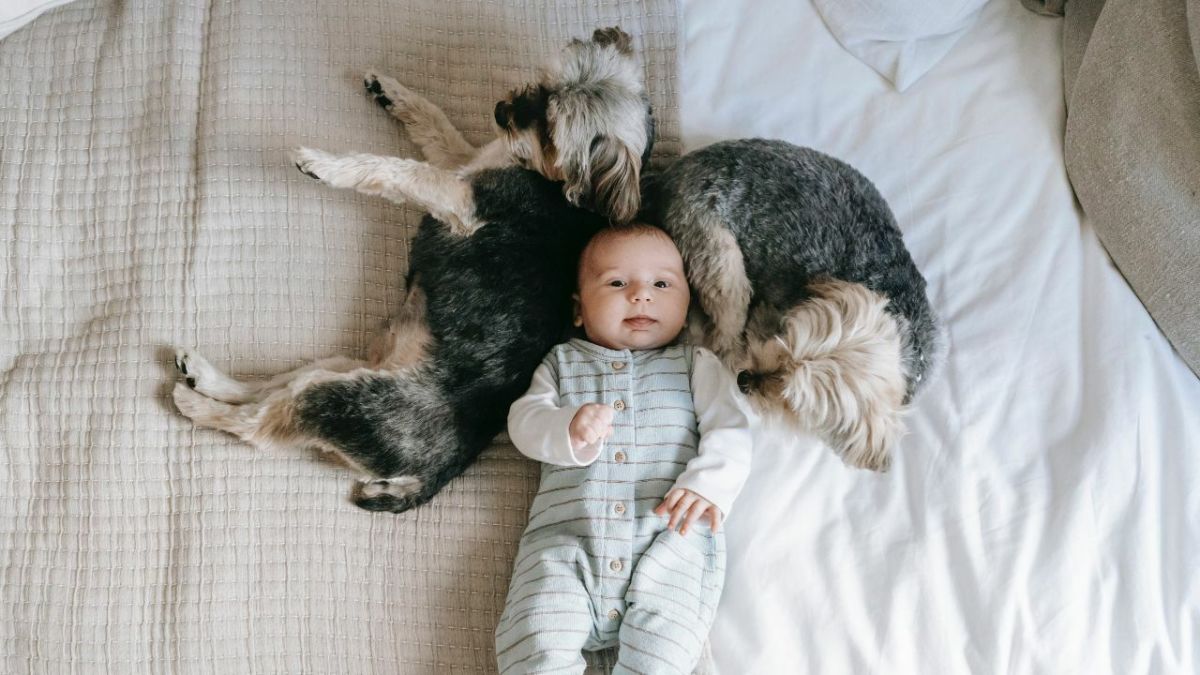
Does your dog seem a little obsessed with your newborn baby? Bringing a new little one home is exciting for the whole family, but what does your dog think about this massive change? Perhaps your pup follows the baby around, barks or whines more frequently, or even tries to lie on top of them. You may wonder if your dog’s intense interest is a form of protection, an obsession, or even jealousy. Let’s look at what this behavior means and how to reassure your dog that everything is fine.

Why Is My Dog So Obsessed With My Newborn Baby?
Most of us would agree that dogs are intuitive about protecting their families from other animals or potential dangers. This instinct is ingrained in their DNA, dating back to their days as wild animals.
In the past, dogs were responsible for guarding their pack, and this instinct has not disappeared. So even in a family setting, a dog sees its human family members as its pack and, therefore, needs to protect them.
A dog’s role as a protector in the family is vital, and the bond between a dog and its family is unbreakable. Research has shown that dogs perceive and respond to newborns in a different way than they do to adults. They have an innate ability to sense when a newborn is vulnerable, which triggers their protective instincts.
Protection vs. Obsession
You may wonder how to distinguish between a dog’s obsession and its protective behavior. Let’s break it down simply:
- Protection: Defensive behavior in dogs is natural and should be encouraged as it keeps the baby safe.
- Obsession: In contrast, owners must address a dog’s dangerous obsession with a baby immediately.
Understanding Protective Behavior
So, why are dogs typically attracted to newborns? It’s because a dog protects a young child instinctively. The following ways show evidence of this:
- Standing guard over the baby and watching it attentively.
- Being more alert and responsive to potential threats or dangers in the environment.
- Becoming more affectionate and defensive of the baby.
Reacting this way is not only natural but can also be beneficial for the family’s safety. A dog’s protective instincts can provide new parents with security and peace of mind.
To encourage and support these instincts, new parents can:
- Take their dog to obedience training to help them respond well to commands and cues.
- Include their pets in baby-related activities and familiarize them with the child’s scent and presence.
- Offer a designated spot near the baby’s crib or play area where the dog can feel helpful by keeping a watchful eye.
It’s helpful for pet parents to realize that protective behavior differs from aggression. Dogs won’t hurt a child unless they feel a genuine threat. Providing necessary training and guidance is the most effective way to channel a dog’s protective behavior positively and safely.
Understanding Obsessive Behavior
When a dog becomes overly fixated on a newborn, it can indicate obsessive behavior. This kind of behavior can show up in various forms, such as:
- Constant barking
- Whining
- Following the baby around relentlessly
This additional noise and chaos can be stressful for new parents and even risk the baby’s safety. So, promptly addressing obsessive behavior helps to ensure everyone’s well-being.

What If My Dog Is Overstimulated by a New Baby?
When it comes to addressing obsessive behavior in dogs, particularly around babies, some kind and effective ways include:
- Redirecting the dog’s attention to physical activities or chew toys focuses on something else, easing fixation on the child.
- Positive reinforcement training rewards the dog for good behavior and ignores or gently corrects negative behavior.
- Obsessive behavior may indicate stress or anxiety in dogs, so addressing the underlying issue may be necessary.
Can Calming Supplements Help?
An excellent way to calm your pup is with Purina Pro Plan Veterinary Supplements Calming Care. Unlike many calming products, this probiotic contains a specific strain that has been studied for its effects on stress and anxiety in dogs. Calming Care may help promote relaxation and emotional balance over time. The result? Your dog may feel more relaxed and comfortable, and the baby won’t be harassed as much.
Can Dogs Like Newborn Babies Too Much?
While a dog’s love and protective instincts towards a newborn are heartwarming, there can be too much affection. When a dog becomes overly fixated on a baby, this can risk the child’s safety.
Signs of a dog obsessing over a newborn too much may include:
- Constantly following or staring at the baby.
- Attempting to lie on top of or close to the baby.
- Signs of agitation or jealousy when someone else holds or cares for them.
- Becoming possessive and showing aggression towards others.
Important!
Please continually monitor interactions between young children and dogs because dogs can be unpredictable.
Training and Management
Proper training and management play a key role in shaping a dog’s behavior around children. Here are some tips and techniques to help your pet become comfortable around your newborn from day one:
- Start by introducing the dog to the baby’s scent before they come home from the hospital. You could do this by using a blanket or clothing that the baby has used.
- Take the initial introduction slowly and gradually, starting with short visits and progressively increasing the time.
- Offer a reward for demonstrating calm behavior, such as staying in a designated spot or lying down quietly beside your child.
- To promote good behavior, use positive reinforcement like rewards and compliments.
Managing a Dog’s Behavior Around a Newborn
To prevent any accidents or injuries, you can follow these tips to teach your pet how to act appropriately around your little one:
- Always supervise interactions between the two of them.
- Keep the baby’s room off-limits to the dog until it has learned to behave appropriately.
- Use baby gates or crates to keep the dog away from your baby when you can’t supervise.
- Avoid leaving them alone together.

Tips to Deal With Jealousy in Your Dog
Just because a dog is protective doesn’t necessarily mean they feel jealous or possessive. However, it may indicate they feel left out or neglected and attempt to come between you and your child, another family member, or even another pet. Jealous behavior can manifest in various ways, such as:
- Acting out or misbehaving to get attention
- Showing aggression or hostility towards the baby or other family members
- Becoming depressed or withdrawn
- Losing appetite or interest in activities
Dogs that experience this emotion may perceive others as competitors for your affection and attention; this explains why they may try to position themselves between you and the other person or animal. Perhaps they sometimes even challenge your spouse when they attempt to get close.
So why do dogs sometimes act in such a jealous manner? Why are they jealous of a tiny newborn baby? The reason is simple: your dog is driven by a fear of losing your love and affection.
How to Make Your Dog Feel More Valued
For your pet to feel more valued and part of the family, consider spending quality time alone, playing with toys, walking, or cuddling. Including them in baby-related activities, mainly feeding, changing, or bathing, can also be beneficial.
Top Tip!
You’ll see more excellent results by praising and rewarding the dog for being calm and gentle around the baby rather than scolding or punishing them for acting negatively.
A dog obsessed with a newborn baby may be overstimulated, anxious, or struggling with boundaries, so calm training and supervision matter.
Final Thoughts
A dog’s love for a newborn can be both beautiful and challenging. Understanding the difference between a dog’s obsession and its protective behavior can help you know how best to deal with the situation. Likewise, proper training and management are key components to help a dog adapt to a new baby’s arrival.
It may help to remember that a dog’s behavior is natural and doesn’t reflect its love for the family. Their protective instincts are so important to the family dynamic, and so is their unconditional love for the newborn.
Do you think your dog is obsessive or protective? Let us know in the comments below!
Sources and Further Reading
- Can Dog Like Baby TOO Much? | Baby Safe Dog Training
It is so much easier to work with a friendly, curious dog to develop self-control and some boundaries than it is to work to change the mind of a dog who is leery of your child. - Dealing With Obsessive Dog Behaviors | Cesar’s Way
Learn how to identify and correct obsessive behaviors in your furry friend. Cesar gives some points to consider. - Why Do Dogs Protect Human Babies? | A Look at Their Relationship
Why do dogs protect human babies? The unique and special bond between infants and canines is unlike any other relationship. - A Closer Look At Aggression In Both Dogs And Cats | McCleary Animal Hospital
It’s not always easy to determine if your dog is acting out because he’s trying to protect you or is jealous or possessive. Sometimes it could be all three, but there is a difference.