A dog owner recently wrote to yourpetsathome.com asking about non-surgical options for a dog with luxating patella. Surgery is often recommended when the condition becomes severe, but not every dog is a good surgical candidate, and not every owner can afford the procedure.
With more people asking about peptides, collagen, and joint supplements for dogs, Dr. Mark explains below what may help, what still needs more research, and when surgery is still the best option.

What Is Luxating Patella in Dogs?
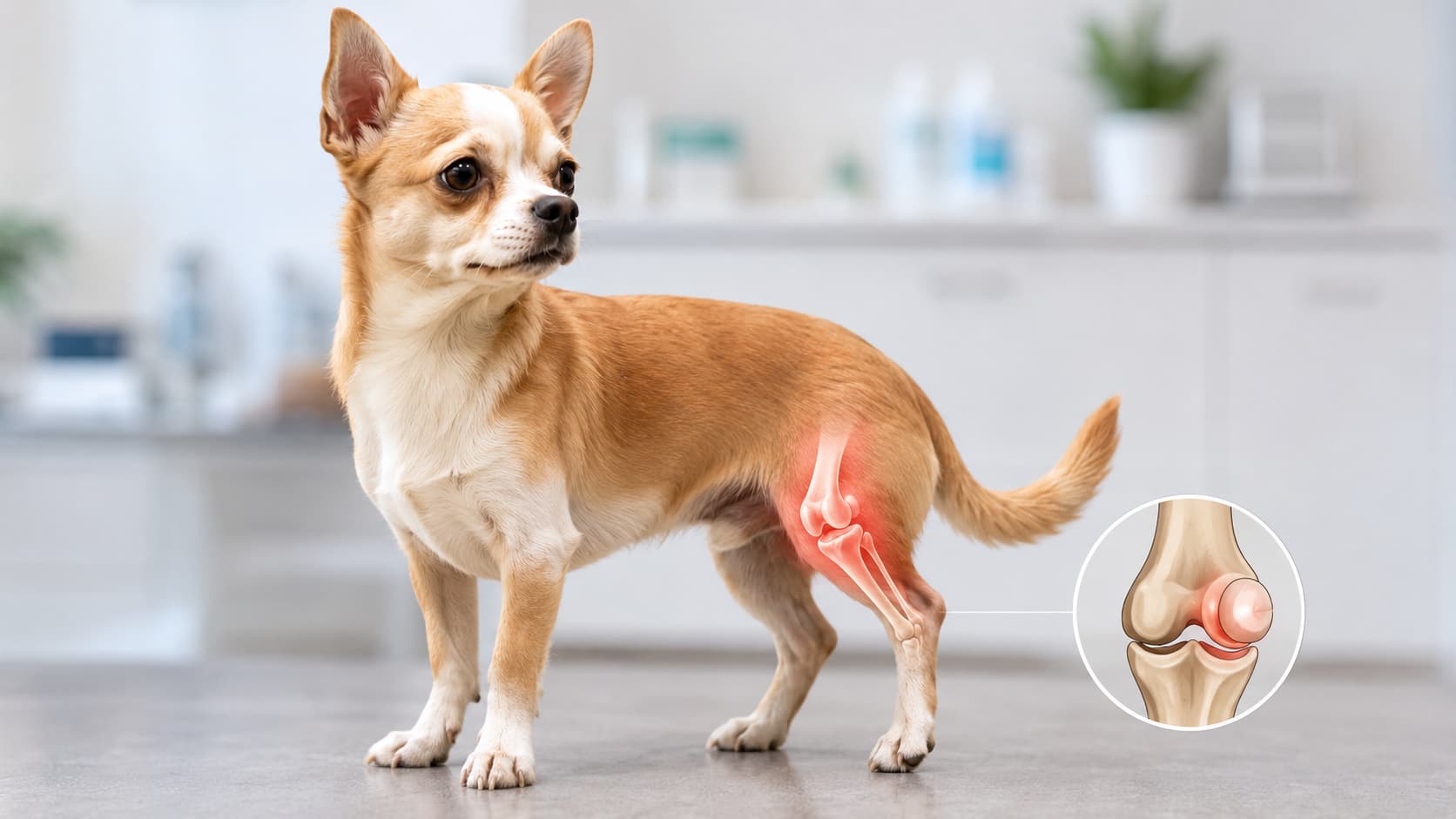
Luxating patella is common in some types of dogs. They are born with a kneecap that slips out of the groove where it is supposed to move, so the whole knee does not function properly.
At first, a dog may only skip occasionally and seem fine again after a brief massage.
Luxating patella is seen often in small dogs such as Maltese, Chihuahuas and Toy Poodles. It can also happen in larger breeds, including Labrador Retrievers, Great Danes and Saint Bernards.
When Luxating Patella Gets Worse
This problem can often be managed when it first appears, but it may become more severe as a dog gets older.
Some dogs end up in a lot of pain. In severe cases, the kneecap may no longer return to its proper position.
By the time a dog has Grade 3 or Grade 4 degeneration of the knee, or is in a lot of pain from knee arthritis, surgery is often presented as the only option.
What Does Luxating Patella Surgery Involve?
Surgery is performed so that the groove can be deepened, the ligaments can be moved so the knee is held in place, and sometimes the capsule that encases the knee is tightened.
If the surgery works, the kneecap no longer pops out of place when the dog walks, and the arthritis does not progress as quickly.
Why Surgery Is Not Always an Option
Surgery is not possible for every dog owner. It may cost as little as $1,000 or as much as $5,000 per knee, depending on the surgeon and the veterinarian’s location.
Not everyone can afford that. Some dogs also have other health problems and may not be good surgical candidates.

What Are the Alternatives to Surgery?
There are several things that can be done if a dog cannot have surgery. The first is weight control.
Excess fat tissue produces pro-inflammatory compounds called adipokines and cytokines. These make the knee worse, and each time the dog moves, excess weight causes more trauma.
Other common therapies that have been tried as alternatives include exercise, glucosamine, omega-3 fatty acids, collagen, pain medication and, more recently, peptides.
Exercises to Strengthen the Leg
There are several ways to strengthen the knee. The exercise can be as mild as hill walking or walking up and down stairs, if you cannot take your dog out on a leash.
As the quadriceps muscle becomes stronger, the tendon between the knee and the muscle becomes tighter. This makes the kneecap less likely to slip out of position.
Dogs can also be trained to walk over cavaletti, which are raised bars that encourage them to pick up their feet and strengthen the stifles.
Swimming may also help strengthen the leg without putting weight on it. If available, an underwater treadmill is another useful option.
Glucosamine and Omega-3 Fatty Acids
Glucosamine is given to protect a dog’s knee by producing more fluid for lubrication and reducing inflammation.
Omega-3 fatty acids replace fats in the cell walls that cause inflammation, which can lead to a swollen and painful knee.
Research on glucosamine is mixed, and it does not always help. In some cases, however, it can make a dog feel better.
The best supplements combine glucosamine with omega-3 fatty acids from green-lipped mussels. Some also contain natural pain-control ingredients, such as curcumin and boswellia.
(Dr. Mark recommends this glucosamine, green-lipped mussel, curcumin and boswellia joint supplement.)
Pain Medication for Luxating Patella
Pain medication has to be used in most cases, but the best pain medications are available only by prescription.
Galliprant is commonly prescribed for arthritis because it controls pain without the side effects of older NSAIDs such as aspirin.
Another medication called Previcox, or firocoxib, performed even better in studies of dogs with knee pain. (1)
There are no good non-prescription alternatives. Aspirin is available for owners who cannot afford prescription medication, but it is less effective and has many side effects.
These side effects can include stomach bleeding and kidney damage. The risks are more severe when aspirin needs to be given all the time, so it is not a good option for dogs with knee arthritis.
Natural alternatives such as boswellia may be less effective, but they can help in minor cases or where prescription pain medications are not available.
Can Peptides Help Dogs With Luxating Patella?
There is another type of medication being used by humans that may help dogs in the future. These are peptides, which are amino acids that tell injured body parts what needs to be done and what changes should be made for faster healing.
When dogs have arthritis secondary to luxating patella, several peptides being investigated may help decrease inflammation and repair tendon and ligament damage.
BPC-157
BPC-157 may promote new blood vessel growth and aid repair of the ligaments that help hold the kneecap in place.
TB-500
TB-500 is another peptide that might help. This amino acid stimulates new cells to move into an injured area, so it may speed up repair of damaged ligaments in the knee.
ELHLD
ELHLD is a peptide intended to protect the joint from further wear.
It has been studied and shown to be effective after surgery in dogs. (2)
It has not yet been studied as an alternative to surgical repair.
What Are the Risks of Peptides?
Other peptides have been tried with some success, but at this time most anecdotal reports involve BPC-157, TB-500 and ELHLD.
Unfortunately, cancer also needs new blood vessel growth in order to enlarge, so releasing a growth factor that does something similar to BPC-157 may carry risk.
We still do not know whether a small cluster of cancer cells could be stimulated by an injection given to help a dog’s knee.
For a dog with an increased cancer risk, such as a Bernese Mountain Dog, peptides may not be worth the risk until more information is available.
Collagen for Dogs With Luxating Patella
Although peptides are a promising field and may help dogs in the future, the most helpful therapies right now are weight control, exercise, glucosamine, omega-3 fatty acids, and collagen.
Glucosamine helps lubricate the knee. Collagen provides amino acids that may help the joint heal and slow the inflammation caused by arthritis.
The type of collagen linked below has been reported to be more effective than commonly used glucosamine in animal health studies involving knee problems. It can reduce inflammation, which may eventually reduce cartilage damage. (3)
(Dr. Mark recommends these UC-II type II collagen capsules.)
This should be given at 40 mg, or one capsule, once a day.
So What Is Best for My Dog?
The best treatment depends on the individual dog. In most cases, it is best to treat your dog conservatively when the problem first appears.
Weight control and mild exercise are good ideas for all dogs. They are especially important for dogs with luxating patella.
Glucosamine is an inexpensive treatment that may help more in the early stages than later on.
Collagen should be started as soon as the problem begins.
As the condition becomes worse, pain medications will be needed. The newer prescription pain medications are more effective, but natural pain medications such as turmeric are also an option.
When the condition becomes so severe that the kneecap is usually luxated or no longer goes back into place, dogs will be in pain more often. At that stage, surgery is the best option.
If your dog is not a surgical candidate, he or she should continue with the conservative methods discussed above.
What About Peptide Injections?
Peptide injections may help, but there are still no research projects proving that they work for luxating patella in dogs.
So far, the evidence is anecdotal. In cases where BPC-157 has appeared to help, it has been given subcutaneously at 500 micrograms twice a day for two weeks.
If you want to try these compounds based on anecdotal success in humans with arthritis secondary to luxating patella, you will need to find a holistic veterinarian willing to work with you and your dog.
If you do not have a holistic veterinarian, peptides can be obtained online, but they are labeled for research purposes only and should be discussed with a veterinarian before use.
Try the more traditional therapies first, including weight control and the glucosamine mixture suggested above.
Can the Alternatives Save My Dog’s Life?
The most common medical reason for euthanasia in senior dogs is arthritis.
This often affects larger dogs that are too big to carry in and out of the house, but it can also happen to small dogs when their pain can no longer be managed.
If you notice that your dog is skipping and has a luxating patella, start taking care of it right away.
If you have any questions, you can send them to our team at YourPetsAtHome.com.
References
- de Salazar Alcalá AG, Gioda L, Dehman A, Beugnet F. Assessment of the efficacy of firocoxib (Previcox®) and grapiprant (Galliprant®) in an induced model of acute arthritis in dogs. BMC Veterinary Research. 2019;15(1):309. doi:10.1186/s12917-019-2052-0. PMID: 31464629; PMCID: PMC6716846. https://pubmed.ncbi.nlm.nih.gov/31464629/
- Lee J, Yoon HY. Effect of ELHLD peptide for stifle function recovery after tibial plateau leveling osteotomy in dogs. Journal of Veterinary Science. 2025;26(1):e6. doi:10.4142/jvs.24154. PMID: 39749381; PMCID: PMC11799084. https://pubmed.ncbi.nlm.nih.gov/39749381/
- Gencoglu H, Orhan C, Sahin E, Sahin K. Undenatured Type II Collagen (UC-II) in joint health and disease: A review on the current knowledge of companion animals. Animals. 2020;10(4):697. doi:10.3390/ani10040697. PMID: 32316397; PMCID: PMC7222752. https://pmc.ncbi.nlm.nih.gov/articles/PMC7222752/
Veterinary Disclaimer
This article is for informational purposes only and is not a substitute for veterinary diagnosis or treatment. Always speak with your veterinarian before starting supplements, changing pain medications or trying peptide injections.
This post contains affiliate links. As an Amazon Associate, I earn from qualifying purchases.